


Finding Wildness in Suburbia
- Ken Campbell
- Nov 2, 2025
- 25 min read



Encounter with a Wild Elk in Suburbia
Jean and I live with our daughter’s family on a small 35-acre farm in the suburban/rural area just south of Seattle. The family named the farm, “Soggy Bottom Farm” (SGBF), in recognition of the fact that it sits in a hollow with an abundance of meadows and wetlands. The farm is only 5 miles away from brother George’s (and his wife, Audrey) 40-acre home and property. Both SGBF and George’s property are surrounded by smaller parcels within a hodgepodge of incorporated and unincorporated communities with roads, schools, shopping areas, parking lots, parks, municipal buildings, hospitals, fire stations, etc. Despite the surrounding development, it is usual to see many forms of wildlife at both SGBF and George’s place.
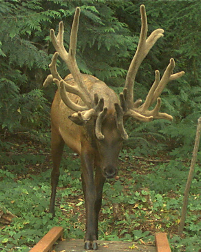
A small cadre of 4-6 bull elk visited SGBF in the summer of 2025. When they first arrived in early June, their antlers were in the early stages of yearly re-growth. A plethora of points were emerging in the nascent antlers of two of these bulls. We called these bulls Cluster Head 1 and Cluster Head 2; CH1 and CH2, respectively. The protagonist in this essay is CH2I obtained several pictures of CH2 with my inter-changeable lens, mirrorless camera (Left Panel, July 19). Also, many pictures were obtained with the trail-cameras that were stationed around the property (Right Panel, July 18). He was commonly observed all during the 2.5 months that his antlers grew from soft, emerging stubs (early June) to the magnificent, antler rack (mid-August) that will serve him during the breeding season. My last trail-camera picture of CH2 at SGBF was on August 19th. We did not see him at SGBF thereafter.
However, in early September, two weeks after CH2 was last seen at SGBF, George reported that a big bull was appearing regularly at his place. On September 4th, I went to George’s place in the late afternoon and, using the car as a shield on his driveway, took some pictures of this elk from a distance. Between the pictures that George and Audrey had obtained and the ones I took, we determined that the elk on their place was indeed CH2.
At this time, all the decent pictures that I had of CH2 were all taken at SGBF when his antlers were still in the development stage and covered with velvet. I did not have a good picture of CH2 with fully-developed, velvet-free, bone-hard, mature antlers. I wanted such a picture.
CH2 was regularly foraging under George and Audrey’s apple trees. This warranted an attempt at a picture session using a photo blind and a wait for his next visit to get the mature antler picture I wanted. On the afternoon of September 6th, I went to George’s place and, at 4:15, set up a photo blind.
My photo-blind was in some bushes at a spot that I thought provided adequate cover, offered a decent view of the photo field where I expected the elk to forage, and took advantage of good late-afternoon light for quality photos. The location was closer to CH2’s forage area under the apple tree than I liked but it offered pretty good cover - there was both low-growing bushes and overhead cover provided by a tall bush. I carried one of George’s firewood rounds into the bushes to provide a place for sitting as I waited.
I kept an eye out on all the pathways that I thought the bull might use on his way to the apple tree.
Waiting in a photo blind can be long and monotonous. I waited for an hour and a half without any sign of a nearby animal. As evening’s light began to dim, I decided I would stay just one more half hour.
I glanced down to look at the clock on my phone and then looked up to see CH2 standing right in front of me, no more than 25 yards away. I my cover was blown, he was looking straight at me. How he got there without me seeing him coming on one of the pathways I do not know. He just kind of materialized.
The elk and I were at a standoff; each of us mesmerized and locked-in on one another’s eyes.
After what seemed to be minutes of eye-to-eye communication (Who are you? What do you want? You are too close to me. I am out of here.) over a very short sight line. I had to move to adjust the camera’s exposure and focus which caused CH2 to decide that our staring at one another was enough and he faded into the nearby brush. I tried to get some pictures by following him into the bushes. But he watched my every move and adjusted his position accordingly such that he always remained obscured by the brush. He didn’t run away. He moved just enough to keep a buffer of concealing brush between the two of us.
None of the pictures I took were of the quality I wanted for a detailed photo-portrait. The best of the bunch is shown on the right.
Next time, I will need to take a stand farther away from his feeding area and make sure that he doesn’t catch me unawares as he did on this occasion.

Can Wildness be Found in the Eyes of a Wild Animal?
A singular moment in the CH2 episode was the brief eye contact between me and the elk. It is broadly understood that "A look into another’s eyes can reveal that person’s soul.” This refers to the metaphysical concept that eyes serve as a window to a person's true self, emotions, and spirit. This concept has been broadly applied to go beyond people and to also apply to eye-to-eye contact between people and animals.
Relevant to our consideration here is an experience of the famed naturalist and father of wild life management: Aldo Leopold. In his early days, Leopold worked for the Forest Service in Arizona and New Mexico. One day in the mountains, he had just watched a wolf cross a river. In his words – “In those days we had never heard of passing up a chance to kill a wolf. In a second we were pumping led into the pack. …. the old wolf was down and a pup was dragging a leg into impassable slide-rocks.
We reached the old wolf in time to watch a fierce green fire dying in her eyes. I realized then, and have known ever since, that there was something new to me in those eyes something known only to her and to the mountain. I was young then, and full of trigger-itch. I thought that because fewer wolves meant more deer, that no wolves would mean hunters paradise. But after seeing the green fire die, I sensed that neither the wolf nor the mountain agreed with such a view.”
The take-away here is that Leopold clearly received a powerful message from the eye-to-eye contact he made with the dying wolf. It was a message born from the innate wisdom contained in the wildness that resided in that wolf’s soul. Basically, this message was in the covenant of the wild that governs the relationship between the mountain and all the denizens that lived upon it:
a functioning ecosystem, one that collectively, with all its parts, has evolved naturally, needs all those parts to maintain the biological balances that allows it to function. Those balances result from multiple regulatory feedbacks between all the living elements in the ecosystem.
That discerned wisdom changed Leopold’s perspective forever especially on the value of predators in an ecosystem and on the important role of predators in the management of wildlife. That perspective has repeatedly gained traction among wildlife biologists as they have documented, from many observations, the important role of predators in the control of animal populations.
This discovery, call it “top-down regulation of animal numbers”, is counter to the implicit message one receives from the ecological food pyramid where decreasing numbers of animals are found at each level as one ascends the pyramid. This implies a regulation of numbers due to limitation on food resources offered by the biomass at the lower level of the pyramid – call it “bottom-up regulation of animal numbers.” Thus, there is greater biomass of producers at the bottom of the pyramid than there is of consumers at the next level up. Correspondingly, there is a greater biomass of consumers at the mid-level than there is of predators at the top of the pyramid. Bottom-up regulation was a well-entrenched concept for years before top-down regulation was broached as a coexisting regulatory process controlling animal numbers. Leopold was an early ecologist to recognize the importance of top-down regulation.
In addition to controlling animal numbers, top-down regulation has the added effects of altering ecosystem structure and bio-diversity. This effect is known as the keystone effect in a trophic cascade. Illustrative examples of this top-down effect are in the response of tidal ecosystems to the removal of predatory starfish from tidal pools; the disappearance of kelp forests in marine waters that have been depleted of sea otters who predate on sea urchins who, in turn, eat kelp; the increase in numbers of baboons in Ghana (and their role as agricultural pests) following the removal of the predatory lions and leopards; and the re-establishment of healthy riparian zones in Yellowstone after the reintroduction of wolves and their subsequent predation on elk, deer, and bison who ate the riparian vegetation and trampled the stream banks.
Now, not all of that discovery came about because someone looked into the eyes of a predator – it is hard to look into the eyes of a starfish. But the essence of the general idea that underlies all of these observations (which had not been articulated at the time) came to an influential wildlife biologist when he looked into the eyes of a dying wolf.
I Appeal for Understanding through the Eyes of a Dying Buck Deer
Like Leopold, I found a similarly profound message in a couple of eye-to-eye-epiphanies that I had 25-years ago with buck deer at our cabin in the Clearwater River Canyon. In these cases, the message I received was more emotional than wise but none-the-less, every bit as compelling.
At the time, I was exploring the spirit-like qualities that could be found in wild places. Our Clearwater Canyon property provided a creditable “wild place.” It was plastered on the side of a steep, 1600 ft high canyon side marked by basalt cliffs, rock taluses, and pockets of brush and pine trees. One ravine - I called it the “East Ravine” - was especially hard to get to and very few people ever attempted to go there. It was a truly wild place.
Deer on the other hand, often travelled through the ravine and often hung-out in the ample cover it offered. If a deer was startled on any part of the property surrounding the cabin, it would flee to the apparent safety of the East Ravine and disappear. In the evenings, when deer started to move around on the canyon side, big bucks seemed to emerge from that mysterious ravine and I would see their silhouettes on the skyline before they disappeared into the blackness of the hillside.
I tried to capture those mystical feelings that arose from the wildness of that place in the following journal notes, which document the sad denouement of one of those big bucks in the proximity of the cabin.

Journal entry: 18 Nov 2008 . It was mid-day in the middle of November and I was walking to the bunkhouse when I saw a large whitetail buck come over the central finger ridge from the East Ravine. Breeding season was in full swing else the buck would not be out in broad daylight. He traveled down the grassy slope leading into the west ravine and entered the brush field above the bunkhouse. Once in the brush, he disappeared.
I went to work splitting wood. I put aside the splitting mall on occasion, picked up the binoculars, and scanned the brush in the ravine above the bunkhouse. I spotted the buck in the brush on one of these scans as he approached a doe. The two animals were soon lost from my view in the dense overgrowth. I went back to splitting wood.
Suddenly, a fusillade of rifle shots from just up the hill rudely shattered the afternoon’s tranquility. I grabbed the binoculars and moved out to where I could see what was going on. Two hunters were shooting into the ravine. They were obviously shooting at the deer that I had just seen. From their shouts and loud conversation, it was clear that they had hit and downed one deer and had shot at another. They separated. One went to the deer that had been downed. The other went after the deer that had gotten away.
I was angry for a complex set of reasons that I couldn’t rationally articulate. But I was prepared to vent my irritation as I trudged up the hill to confront the hunters. I met Brian before he got to his downed buck. Brian was young, maybe 22-24 years old. He was disarmingly polite and apologized for shooting so close to the house. He claimed that he had permission from the landowner to hunt. In fact, his landowner’s property lay further up the canyon side near the rim. I said little and told him that we needed to find the downed deer. We soon found it, struggling weakly to get up. The deer’s back was broken and it may have received additional wounds.
Brian was excited - the 5x5 whitetail buck that lay on the ground before him was larger and grander than any he had previously seen. To administer a coup de grace, he unsheathed his hunting knife and clumsily stabbed at the animal’s heaving rib cage without penetrating the skin. I took Brian’s knife from him and took out my own pocketknife. Having vested much of my professional life in attending to injured animals, I was confident in the proper way to deal with this poor wounded beast. I knelt against the animal’s back safely out of the way of flailing hooves. I grabbed his antlers and twisted his head back. I pointed to the jugular fossa at the entrance to the thoracic inlet and explained to Brian that a deep knife thrust there would sever the carotid artery and cause bleeding into the thoracic cavity. The deer would quickly bleed to death without a bloody mess and a gaping wound. I thrust my knife into the fossa moving the tip of the blade deep in the thorax so as to slice an arc that would surely cut the artery.
I looked into the deer’s eyes as life’s tension left its body. Were these the same eyes that just one week ago saw me move on my stand under the sentinel pine and whose gaze locked with mine for 5 minutes as each of us planned our next move? Then, the distance between our eyes had been 200 yards, now it was 3 feet. Even at this close distance however, I knew that I could not communicate that I was sorry – sorry for what happened to him; sorry that, for the sake of compassion, I acted to hastened his death. The wildness that emanated from those eyes began to dull, the force that sustained the deer’s life weakened and then mercifully, all evidence of life disappeared as his eyes glazed over. I let go of the antler and his head rolled sidewise.
I continued to kneel beside this wonderful animal, his body pressing against my knees, my head bowed. A deepening sadness replaced my anger. This deer would no longer eat my apples or drink the water in my watering trough. He no longer would lead me into the east ravine and the special wilderness that was there. And as evening’s twilight turned into night, he no longer would show up on the skyline and provide the image that sustained the myth of the giant buck.
I Discover Spiritual Dimensions of Wildness in Eye-to-Eye Communion with a Mythic Buck
At the upper end of the East Ravine, a lone pine tree rose monolithically from the steep slope of a rock talus. I called this tree the “Sentinel Pine” because of the commanding view that could be had of the surrounding area from that location. At the base of the tree was a mound of dirt created by a badger’s digging. Sitting on that dirt mound, one could surveil the downhill area of the ravine and the surrounding hillsides that led into the ravine. Even though it was a difficult place to get to, I sometimes went there early in the morning when I felt the need for nature-communion time. The following journal notes describe a transformative, mind-expanding experience of an encounter with a big, ghost-like buck deer in the East Ravine while I was sitting at the base of the Sentinel Pine.
Journal entry: 2 Nov 2010 . Two years after the sad death of the beautiful whitetail buck above the bunkhouse, I visited the sentinel pine in the late-autumn. As I rose from my observation seat at the base of the tree, I glanced downhill. There on the trail I had just traveled, only about 80 yards away, was the largest mule deer buck that I had ever seen. I don’t know how he got to that place on the trail without me seeing him earlier. My view of the brush fields and canyon sides was such that he couldn’t have come from those areas without my notice. Either he came up the ravine through the heavy brush and pine grove as I had or he just materialized. In any case, he came to me!
Did I say this mule deer buck was big? He was big in body - wide back, deep chest, thick neck, and heavily muscled. He was big in antlers – his rack was high, wide, and heavy and each of the four antler tines on both sides was long and straight. He was big in facial appearance - his black nose was followed by a white muzzle and then a black brow line on his forehead that demarcated the grey skull cap from which sprouted his spectacular mahogany-colored antlers. His size matched his bearing, which was that of a monarch.
From where he stood, this big buck boldly confronted me. He and I looked at one another for a long time – we looked into each other’s eyes in a virtual replay of the eye-to-eye exchange I had 2 years earlier when I first encountered a large whitetail buck at this spot. However, there was something about eye-to-eye contact with this big mule deer buck that transcended everyday experience - a transcendence where the rest of the world dissolved and all of existence collapsed around a sightline between me and the big buck. The distance between us on this sightline shrunk until the deer seemed very close.
Then,a communion took place that connected my spirit with that of the deer. At that moment, the buck and I became fellow creatures that shared a common place in this world; a primal place where man’s separation from nature no longer existed. And in that primal place, there was spiritual rhapsody; an ecstasy that cannot be found in mortal life.
Our little séance ended when, to my surprise, the buck turned and continued on the trail in my direction. He stopped to look up at me again and then as if to send a message, he viciously beat and broke the branches of a serviceberry bush with strong antler strokes that sent pieces of bush in all directions. His path took him into the bottom of the ravine and out of sight in a gully behind a tangle of hawthorn and serviceberry. If he continued on that trail, he would again come into my sight at the edge of the small clearing only about 30 yards away. I waited and wondered what he was up to. Was there more to this spiritual communion than just took place? Was I guilty of spiritual trespass and was I going to have to answer for my presence in his sacred ravine?
The wait was prolonged. Something had changed. When the buck arrived at the clearing’s edge, his demeanor was different. No longer bold and assertive, he now seemed distracted and aloof. He didn’t look at me even though he was now very close – it was as if my physical presence was of no concern. Instead, he looked straight ahead - the presence he sensed was farther away; farther in distance and, maybe, farther in time. After standing still for a protracted moment at the clearing’s brushy edge, he quickly crossed the opening and entered the brush on the other side. He continued through the brush, climbed a steep cobble-strewn slope, effortlessly jumped a fence on the face of that steep slope, topped the knife-edge of a steep finger ridge, and disappeared into the cliff country that extends to the east.
When that great buck was present, his aura totally dominated the scene. When he was gone, he was gone completely. Like an evanescent spirit, he appeared and then disappeared in sudden and mysterious ways leaving me somewhat shaken and wondering if he had been there at all.
What was I to take from the encounter with the spirit buck; what was the enduring lesson?
I believe the lesson is this – if one seeks the spiritual dimensions in nature, he must immerse himself in experiences where nature’s mysteries seem ethereal. Once a mystical encounter is experienced and a spiritual message has seemingly been transmitted from an otherworldly presence, a bonding with the natural world takes place. This bonding can be deep such that it marries one’s soul to that of the land. Reflecting on these bonding experiences not only gives more meaning to life but gives an enduring peacefulness to a questioning spirit.

Image Model. This drawing is an attempt to visually represent what I described in the written narrative, i.e., to depict the majesty and boldness of the spirit buck as he and I engaged in our little séance in the East Ravine. Although this drawing was constructed from memory, an honest attempt was made to avoid exaggeration. As we initially met, this bold, majestic buck was patently corporeal with an imposing physical presence. At one point, he viscously beat the brush and sent broken limbs and twigs flying. But, as our séance concluded and he left the scene, he became a disembodied phantasm - his ghost-like departure is depicted by the translucent rendering at the top of the figure. Whatever the Spirit Buck may have been in reality is irrelevant because what I have drawn is the image of the deer as I remember it – a monarch with an ethereal aura reminiscent of a true spirit.
Eye-to-Eye Contact With a Wild Animal can Communicate Wildness Whether it takes place in the Wilderness or in Suburbia
The meeting with CH2 at George’s place took on extraordinary dimensions because of the depth and clarity of the eye contact between the two of us at the photo blind. This parallels to some extent the type of eye contact I had in the encounters with the two bucks in the Clearwater Canyon. It reawakened some of the sensations that I gained from those earlier experiences. In the moment that CH2 and I looked into one another’s eyes, we each probed the substance of the other’s soul. The insight was basically that CH2 and I were fellow creatures that shared a common place in this world. In that primal place, there was spiritual harmony; an interconnectedness that cannot be found in the artificial trappings of modern civilized life.
This connection was made despite that the world in the Clearwater Canyon, where the connections were made with the two buck deer, was essentially a wild, undeveloped world, in contrast to the world at George’s place where I engaged in eye-to-eye contact with CH2 which was essentially a suburban, highly-developed world of houses, lawns, gardens, and driveways sandwiched in between schools, shopping areas, parking lots, etc.
The wild animals that continue to live in the south-Seattle suburbia have found just enough cover, food, and space to adapt to living in that suburban world. Even though adapted, they retain their ancestorial wild character in their souls. So, a meeting of a human soul with a wild animal soul along a sightline in a close encounter, whether in a wild or in a suburban world, could result in the same transformative experience where reality is perceived beyond everyday consciousness.
It is the experiences that expand my perceptions into these primordial realms that drives me to continue to explore nature and interact with the wild animals that live there.
Suburbia Enables a Decrepit Old Man to Continue his Exploration of Wild Nature
However, these explorations must necessarily change as I get older. When I had the encounter with the two Clearwater Canyon bucks, I was 60 years old. Then, I had the vitality to get up before dawn, climb to the top of a 1600-foot ridge, cross along the face of a steep, cobble-strewn slope, find my way through dense brush, and descend 500 feet over a rock talus to the base of the sentinel pine all in the dark with the limited aid of a flash light. The path for this route was more than a mile and it took a robust constitution to make the trek in order to arrive at the base of the sentinel pine before full morning light.
Now, I am 85 years old as I contemplate my next encounter with a wild animal. I do not have the vitality I had 25 years ago. Along with natural age-related declines in physiological robustness (progressive muscle weakness, loss of cardio-pulmonary and temperature regulatory function, decreased endurance, etc.) there are numerous infirmaries that beset my aging body (mild heart failure, recent knee replacement, balance problems that prevent me from walking over rough, uneven terrain). If I am going to explore a landscape for more encounters with wild animals, I will necessarily be restricted to easy-access sites not far from a house or a car. I will need a comparatively gentle path with few obstacles to lead to a place where an encounter is likely. It is doubtful that such an accommodating landscape could be found in a truly wild setting like the Clearwater River Canyon.
And zoos don’t make it. Zoos don’t allow animals to practice wild behavior. A zoo animal can’t exercise stealth or engage in human avoidance, nor can it control its associations with other animals, or select the immediate environment in which it feels most comfortable. It does not have the opportunity to avoid a predator or seek prey or select a diet from the offerings that it finds in its environment. Having lost both the necessity and the opportunity to practice wild behavior, the fire that sustains wildness in the zoo animal has flickered to a low level and the spirit of wildness no longer shines in its eyes. Try making eye contact with a zoo animal and you will find the animal will be indifferent or will avoid your gaze altogether.
In contrast, the suburban animal not only has the opportunity to practice all these wild behaviors but, in some cases, must refine them to the ultimate degree. The mountain lion is perhaps the most remarkable in this respect. In the 14 years that my family members have lived at SGBF, nobody has seen a mountain lion. Yet in the few months between January and August of 2025, we have trail-camera photos of over 40 mountain lion visitations to SGBF. From time-stamps on the photos, I discovered that I sometimes visit camera stations to pick up SD cards and have missed bumping into a mountain lion by only a few minutes. I surmise that, not only in these instances but in many others, the beast was lurking in nearby bushes. How many times have I been in the proximity of a mountain lion and not known it? The mountain lion in the suburban setting is the epitome of wild stealth.
For the elk, the tuning of wild behaviors in suburban settings has taken a somewhat different tact. Hiding like the mountain lion is only part of its avoidance behavior but fleeing to increase the distance between he and ye is central. How and when does the elk flee? Part of the elk’s adaptation to suburbia is to modulate the divide between awareness and alarm. Consider two concentric circles centered on the elk. The perimeter of the largest of these circles defines a limit, beyond which, the elk will take little note of another creature. But inside that perimeter, the elk is aware of any creature that is present – he may not act like he is paying attention but he definitely is. The perimeter of the smaller of these circles defines an area, again centered on the elk, within which the elk will take alarm and execute avoidance behavior in response to any creature with whom it feels uncomfortable. Call these two circles the awareness circle and the alarm circle. Wildness modulates the radius of these two circles and the extent of the divide between their perimeters.
From my experience photographing the elk that visited SGBF this past summer, I learned the extent of the divide between awareness and alarm in this group of animals. I noted that as I approached CH2 to take pictures, he became aware of my presence long before any closeness had been established. I knew that he knew I was there. But, he continued doing the things he had been doing previously, all the while keeping a sidelong attention on my whereabouts. He held his alarm in abeyance. But when I moved forward to get closer for better pictures, I reached a point where CH2 felt that the distance between him and me had closed to the extent that it violated his safe space. Then, in an unhurried way, he disappeared into the nearby brush that hid his escape path.
In a wilderness setting, the divide between awareness and alarm can be several hundred meters but it depends on the animal’s previous history with humans, the vegetative habit and topography of the landscape, and the time of year – seasons affecting food availability, calving, breeding, hunting, migration, etc. all bring about changes in this divide. In a south-Seattle suburb, the divide between awareness and alarm has dimensions typical of a suburban lot. With fewer extreme variation in the suburban environment than in the wild, this divide varies less over the year than it does in animals in the wilderness. This adaptation to adopt city-lot dimensions in the divide between awareness and alarm is necessary if the elk is to cohabit the suburban environment with humans.
In Colorado’s Estes Park, the intermingling crowds of both people and elk have essentially obliterated the perimeter of both the awareness and alarm circles; the divide has essentially collapsed into the elk’s personal space. The elk’s reaction to an interloper into that space is to attack or not. Unlike the zoo, the elk in Estes Park is free to wander its habitat as it may want, but is it wild? The park rangers say it is but the tourists treat it as an animal novelty in their recreational space.
In both suburbia and Estes Park, wildness governs the size of the divide between awareness and alarm and the difference between elk in these two places shows the adaptability of this behavioral feature. But when the adaptation is so extreme as it is in Estes Park, is wildness accessible through the eyes of the Estes Park elk or has it been replaced with aggression as the only remaining component of the wild-behavioral complex?
I claim that wildness has a way of preserving itself in the innate souls of wild animals even if that animal lives in suburbia. Even if the wild animal can adapt to live in the human-altered environments of the suburban landscape, it is possible to find the essence of the wild spirit in the soul of these animals by communicating with that animal through looking into its eyes. Wildness resides in the soul of the beast and the window into the beast’s soul is through its eyes.
The Camera can be a Valuable Tool for Exploring Wildness in Suburbia
For reasons related to the above discussion, it is no accident that wildlife photographers give high value to a clear, bright presentation of the eye in any picture that is to capture the essence of a wild animal. Modern cameras with their sophisticated autofocus capabilities enable the photographer to command the camera to find the eye and focus on it. Thus, when a close encounter and a short sightline cannot be established, the camera, with a telephoto lens, can serve as the next best thing to direct eye-to-eye contact.
The picture below is of the face of one of the bulls in the cadre that accompanied CH2 onto SBGF. Here, the eye plays a prominent role in conveying the attitude and alertness of the animal. The wide pupil gives the impression that there is depth behind the eye that, if explored, could, in an abstract sense, reveal the animal’s soul. The eye in the image almost enables us to make a personal connection with the beast.

The eyes in the elk photo above convey a different sense about the intent and mood of the animal than the eyes of the coyote and of the deer in the photos below. The elk is sanguine; the coyote is menacingly mischievous; the doe is timidly alert; the buck is intent. All manifest an aspect of wildness that is characteristic of each animal’s unique mix of behavioral traits.


Similarly, photos that clearly show the eyes of small mammals gives the observer a more intimate view into the character of these small creatures and their place in their world than if the eyes were poorly represented – both the tree squirrel and the cottontail demonstrate the alertness they need to avoid the coyote and the hawk and owl.

The same can be said for birds as the photos below convey a greater depth of the bird’s essence and its relation to its wild ways than could be extracted from a picture that emphasized merely form, size, and plumage. (Great gray owl on the left, Cooper’s hawk on the right)

The owl appears intense because of its vulnerabilities and its reliance on both sight and sound to navigate its environment; the hawk is malevolent because it must be so to procure its skittish avian food. These two raptors behave very differently and this difference is manifest in the way their eyes are presented.
Clarity of the eye in the photo is important. For instance, in a photo of two of CH2’s associates, the camera chose to focus on the eye of the elk on the right. Because the depth of field was very narrow, the elk on the left is slightly out-of-focus relative to the elk on the right and the eye is a little less bright. Consequently, we get the impression from the picture that we know the elk on the right a little better than the one on the left even though the one on the left has a more interesting antler structure.

I took the above photos through a telephoto lens from a location within the divide between the animal’s awareness and alarm circles; the animals were aware of my presence but were not overly alarmed. It demonstrates some of the rules in using a camera to enhance the wildlife experience.
1) Place emphasis on obtaining a photo that clearly exhibits the eye.
2) Get as close as possible to obtain a photo that exhibits the eye in some depth.
3) Closeness requires knowledge of the animal’s awareness and alarm zones.
4) To bridge the distance across the alarm zone you can use a telephoto lens (which has numerous technical challenges) or establish a hide within the alarm zone that prevents the animal from discovering your presence within its protected space (which has numerous physical challenges and requires knowing a priori where the animal will be).
My failure to acquire pictures of CH2 from my photo blind at George’s place is an example of the difficulties in constructing an adequate hide.
Animals carry their awareness and alarm circles with them as they move through their environment. When I constructed my photo blind near the apple tree, I knew it would be within CH2’s alarm zone when he came to forage on the apples. I thought my cover was pretty good. It wasn’t good enough. When CH2 came to the apple tree he brought his alarm zone with him and it embraced my hide. He didn’t see me at first. But when I moved to the camera to make adjustments prior to taking a photo, he detected me right away. At that instant, we had our eye-to-eye communication episode - this instant was too brief to allow pictures to be taken and CH2 quickly decided to take his alarm zone to a more distant location. A better built hide could have solved this problem.
A necessary condition for taking pictures of wild animals in suburbia, of course, is that wild animals be present. Luckily, we live in a place where there is enough food, cover, and space preserved in patchy areas in our suburban environment to accommodate many native wild animals – they have found suitable habitable niches as they adapted to suburban congestion. In addition, there are corridors of food, cover, and space that lead from our suburbia to the near-by mountains and wild areas. Both suburban-resident animals and wilderness denizens take advantage of these corridors to travel between suburbia and wild lands.
Evidence for the presence of wild animals is in the numerous trail camera photos we have obtained at SGBF of not only deer and elk but, also, of mountain lions, bears, bobcats, coyotes, raccoons, otters, mink, and beaver. Trail cameras will not produce images with the quality that can be obtained with interchangeable lens cameras as seen in the eyes of the animals in the above photos. This, even though it is not uncommon for an animal to nuzzle a trail camera as it investigates it - deer and bear are notorious for this. The result is that the camera takes a picture of the animal’s eye. These pictures have an element of humor associated with them but because they are poorly focused and poorly lighted, they don’t convey the kind of image that communicates the metaphysical aspects that can be visualized in the eyes. In these accidental images, the eye does not serve as a window to an animal's true self, emotions, and spirit.
The value of trail camera photos is not only that they reveal who is there, but also how many, what time of day, and how frequently animals visit certain places. This information can be used to create context and identity and for planning and executing the next wild animal encounter where one has the interchangeable-lens camera in hand. Our trail-camera evidence supports that there is the very real possibility for an animal encounter not only at SGBF but in the backyards of any of the many suburban domiciles that surround us.
I Finaly Get My Picture of CH2
The fall progressed CH2 continued to hang out at George’s place. In early October, he was joined by a small herd of cows, calves, and a couple of young bulls. From reports from the neighbors, which gave accounts of vocalizations and other antics suggestive of breeding behavior, the herd moved between properties with George’s place serving as sort of a home base. Apparently, CH2 took the role of the herd bull. By the end of October, most of the small herd had moved on but CH2 remained at George’s place as if that was his home station.
By the 1stof November, I had visited George’s place several times with camera in hand. It was now post-breeding season and CH2’s demeanor was that of an apparently spent herd bull. Perhaps nursing an injury, he moved slowly. He spent hours bedded in an open pasture chewing his cud. He was attentive to my presence but acted as if the perimeter of his alarm circle had shrunk to the point that he didn’t care if I was there or not. I gave him plenty of space as I took innumerable pictures. Of course, now his antlers were completely mature, bone-hard, and free of the nutritive velvet covering. I had many pictures of the kind I wanted.
One of the pictures that I included in this essay shows him coming out of the forest to his bedding spot in the pasture. The other shows his eye.


Comments